
A map is never just a collection of lines. Behind every border, road and place, there is a story waiting to be discovered.
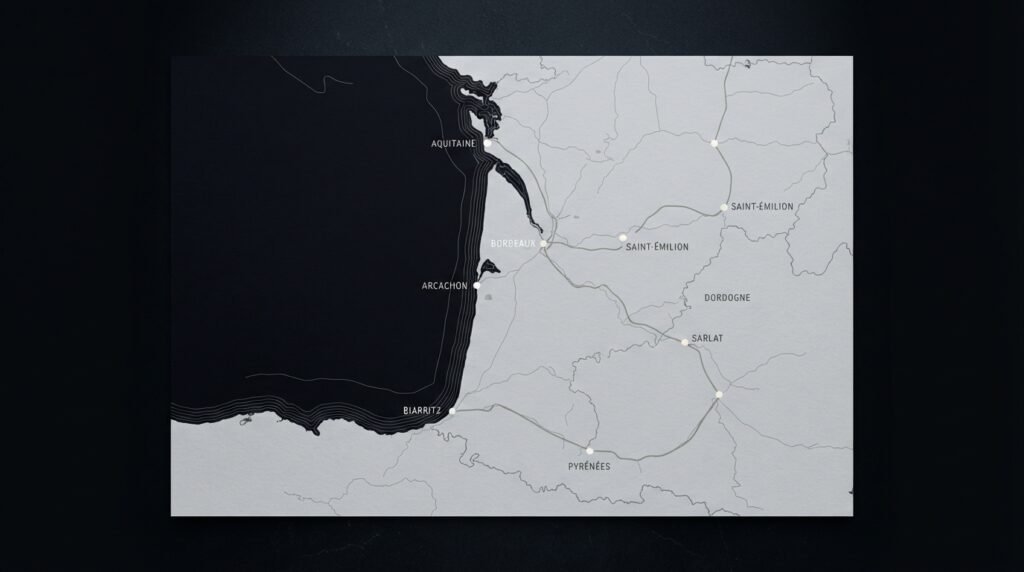
There is something strangely familiar about looking at a map.
Even when we don’t know the place, something about its shapes and lines immediately catches our attention. We look for cities, coastlines, rivers or roads. We follow a route with our eyes. Sometimes we find a place we have visited. Sometimes we discover somewhere we had never heard of.
And before we know it, we are imagining ourselves there.
More than geography
Maps were created to help us understand the world, but their meaning doesn’t stop at geography.
A map can represent a journey, a home, a memory or a destination that has been on someone’s list for years.
Think about a city you know well.
You probably don’t picture every street when you think about it. Instead, a few elements come to mind: a particular neighborhood, a river, a square, a road you have travelled many times or the general shape of the city.
Those details become part of how you remember the place.
A map can capture those details in a visual form.
That is what makes maps so interesting as objects. They can describe a real place while also representing a personal experience of it.
Every line has a purpose
Look closely at a map and you’ll find an enormous amount of information.
Roads cross one another. Rivers divide territories. Borders define countries. Cities appear as points among hundreds or thousands of other places.
Yet the most interesting maps aren’t necessarily the ones that show the most.
They are the ones that help us see the right things.
A single line can suggest a road. A simple shape can define a coastline. A small dot can bring an entire city into focus.
This is where cartography and design meet.
The designer has to decide what deserves attention and what can quietly disappear into the background.
Every line has a purpose, and every omission is a decision.
Maps and memories
Perhaps one of the reasons we love maps is that they give physical form to memories.
A map of a hometown can remind someone of where they grew up.
A map of a country can bring back a memorable trip.
A map of a city can represent the place where a relationship began, a new chapter of life started or an important decision was made.
The geography hasn’t changed.
But the meaning of that geography can be completely different from one person to another.
This is what makes a map surprisingly personal.
Two people can look at exactly the same map and see two completely different stories.
The pleasure of discovering a place
Maps also satisfy something more basic: our curiosity.
There is a particular pleasure in exploring a map without having a destination in mind.
You notice an unusual coastline. You follow a river. You find a small island. You discover the name of a city you’ve never heard of.
It’s a quiet form of exploration.
No plane ticket is required. No itinerary. No luggage.
Just curiosity.
In a world where we can instantly see almost any place through photographs and videos, there is still something special about discovering a location through its shape and position.
A map doesn’t show you what a place looks like.
It shows you where it belongs.
Why minimalist maps feel different
Minimalist maps take this idea one step further.
By removing unnecessary information, they give the viewer more room to interpret what remains. Instead of competing for attention, the elements work together as a composition.
The result can be surprisingly powerful.
A few lines. A handful of names. One carefully chosen point.
That’s sometimes enough.
The map becomes easier to appreciate as a visual object while keeping its connection to the real world.
And perhaps that’s the balance we are looking for at AlejoAyaM: creating maps that are visually simple without becoming empty, informative without becoming crowded, and decorative without losing their meaning.
A place can be part of your story
We all have places that mean something to us.
Some are where we started.
Others are where we changed.
Some are places we return to whenever we can, while others exist only as a future destination waiting to be explored.
A map gives those places a shape.
It turns geography into something we can look at, keep and remember.
Because sometimes, a place is more than a point on the map. It’s part of the story we carry with us.